May 4, 2026

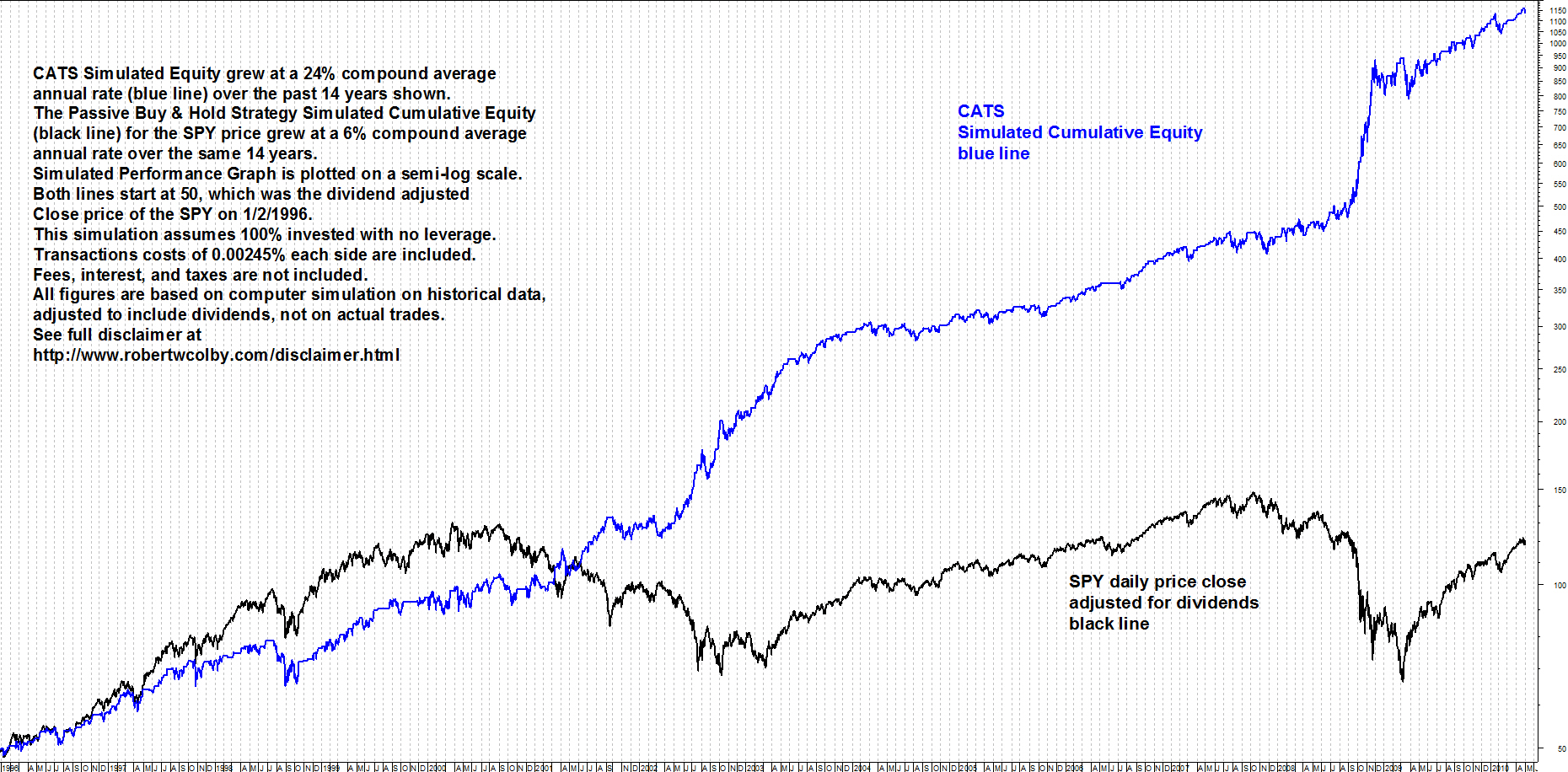
Our Colby CDT program outperformed the S&P 500® Index last year and again this year. All of our asset management clients have made significantly positive relative returns over the past 15 years while taking substantially less risk. We offer complete transparency, anytime access to your funds, and low fees. You keep control over your money. See: ColbyAssetManagement.com

Bullish rotation still favors the large-cap technology stocks.

Stock price indexes tell the story of the day. The big-cap benchmark S&P 500 and the technology-heavy NASDAQ Composite rose to new highs, again proving exactly where demand is strongest in the stock market. Meanwhile, the equal-weight S&P 500 (RSP), mid-cap stocks (MDY), and small-cap stocks (IWM) continue to trail the capitalization-weighted indexes and did not rise to new highs last week. These lagging indexes are not bearish, but it usually pays to follow the momentum: overweight the best performers and underweight the laggers.

Momentum and Breadth

Long-term momentum remains positive and has strengthened across short- and intermediate-term time frames. Of 38 major markets we track each week:

  • 79% are above their 50-day Simple Moving Averages (SMAs), up from 74% a week ago.
  • 79% are above their 200-day SMAs, unchanged from 79% a week ago.
  • 76% maintain a bullish long-term configuration (50-day SMA above 200-day SMA), unchanged from 76% a week ago.

Within the S&P 500, 54.8% of stocks trade above their 50-day SMAs (up from 52.8% a week ago), and 57.8% are above their 200-day SMAs (up from 57.0%).

The Cumulative Daily Advance–Decline Line (A/D Line) finished the week slightly higher. The A/D Line remains bullish, even though it remains slightly below the all-time high set on Monday 4/20/2020 and is lagging the big-cap price indexes.

Net New Highs rose to +147, up from +93 a week ago. Readings above zero for new highs minus new lows are bullish.

Sentiment Indicators

Investor confidence rose after generating contrarian buy signals in March. The VIX Index fell to a below-average 16.99, down from a peak of 31.65 on March 27 (when it was more than two standard deviations above its 10-year mean of 18.79). The AAII Bulls/Bears survey recorded 38.10% bullish versus 39.70% bearish, indicating a little more pessimism than optimism. The Put/Call Ratio fell to a below-average 0.46, down from a peak of 0.90 in March, reflecting a marked move from defensive positioning toward greater risk appetite. The CNN Investor Sentiment Index indicates slightly less optimistic Greed at 66, down from 71 on 4/20/2026. In March, it ranged from 14 to 18, placing it deep in the Extreme Fear zone, a condition that has historically been bullish. Although sentiment is more optimistic now, it has not yet reached levels that would justify a contrarian bearish view. Doubt remains, particularly in the perpetually pessimistic mainstream media.

Sector and Market Rotation

The large-cap S&P 500 ETF (SPY) outperformed the equal-weight ETF (RSP) since 3/31/2026, reversing five months of underperformance that began on 10/29/2025. The SPY/RSP ratio is rising above the 20-, 50-, and 200-day SMAs, again confirming that the market currently prefers mega-cap leadership. Longer term, SPY has outperformed RSP since 2015.

The Technology ETF (XLK, 161.87) rose to another new all-time high and outperformed since 2/5/2026. XLK has crossed above major SMAs, and the 50-day SMA crossed above the 200-day SMA on Friday 4/17/2026, generating a “golden cross” buy signal. Earnings reports have been better than generally expected. The pessimism surrounding AI from November through February has reversed, and short sellers appear to be under pressure.

The S&P 500 Energy Stock Sector SPDR (XLE, 58.85) price crossed back above its 50-day SMA now at 57.68. XLE rose above its low of 53.41 on 4/17/2026 but remains below its peak of 63.46 on 3/30/2026. Although short-term momentum appears bullish, continuation of this rally may depend on developing news about the global oil supply and the war.

International equities have recovered most of their March losses, helped by hopes for a lasting peace agreement with Iran. The Emerging Markets ETF (EEM) and EAFE ETF (EFA) remain above all SMAs, and the 50-day SMAs have remained above the 200-day SMAs, a bullish technical configuration. EEM has outperformed EFA, and all trends point to EEM continuing to outperform EFA.

The China Large-Cap ETF (FXI) declined again last week and has underperformed the S&P 500 for 19 years since 2007. It fell to its lowest price level since May 2025 on 3/27/2026, confirming the "death cross" on 3/11/2026, when the 50-day SMA crossed below the 200-day SMA. Technical conditions continue to point to persistent underperformance, and exposure should be avoided.

Currencies, Commodities, and Fixed Income

The U.S. Dollar Index ETF (UUP, 27.41) price fell below both the 50-day SMA, now at 27.51, and fell below the 200-day SMA, now at 27.54, indicating bearish momentum. The U.S. dollar has remained in a major downtrend since peaking at 30.76 on 9/27/2022.

Precious and industrial metals have been choppy and erratic since the blow-off tops on 1/29/2026. Gold Miners (GDX), Gold (GLD), and Silver (SLV) fell further below their 50-day SMAs last week. Copper (CPER) price also declined but still remains above the 50-day and 200-day SMAs. As a group, metals have continued to underperform the major stock price indexes since January and clearly are not where the action is.

Energy markets continued their rise last week. WTI Crude Oil (CLM26, 101.94) and Oil ETF (USO, 142.80) both rose above their highs of 4/7/2026, confirming renewed upside momentum.  Although long-term technical trends are clearly bullish, continuation of this uptrend may depend on news about the global oil supply and the war.

U.S. fixed income prices remain bearish. The Long Bond ETF (TLT) and U.S. Note ETF (IEF) fell further below their 50-day and 200-day SMAs, and their 50-day SMAs fell further below their 200-day SMAs. iShares Core U.S. Aggregate Bond ETF (AGG, 98.90) also was weaker after triggering a "death cross" on 4/23/2026, when the 50-day SMA crossed below the 200-day SMA. The technical structure for U.S. fixed income prices suggests continuing downside risk and underperformance.

See The Colby Global Markets Report (click here) for our complete analysis of global markets and specific investment rankings.

A strategy emphasizing both capital preservation and return on investment appears most rational and prudent at this time.

Every day, we measure and weigh objective technical and quantitative data in order to judge the Reward/Risk probabilities of trend continuation or reversal. Our goal is to protect your assets from major risks while capitalizing on an improving investment outlook. We always put our clients' best interests first.

Consider exploring our professional fiduciary asset management services to protect and grow your wealth. We are happy to discuss your goals and concerns and answer your questions.

For a free consultation, contact: Bill Anderson Phone: 646-652-6879
Email: anderson@colbyassetmanagement.com


This Technical Analysis is made possible by use of MetaStock software. Try it at no risk for 30 days. (Check out the new and improved version 19.) Click this link to save 7%–9% on MetaStock® software.